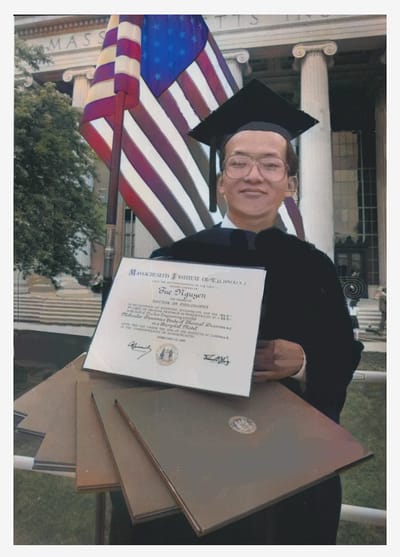
Nguyen Tue co-inventor
The Rad Cam prototypes had already demonstrated impressive thermal efficiency as a power source for light aircraft. However, two critical challenges stalled its development toward providing clean electric energy for EVs:
- The need to design a piston sealing system capable of running oil‑free.
- The transition from conventional spark‑plug ignition to advanced HCCI (Homogeneous Charge Compression Ignition).
After 14 months, Jim’s agreement with the firm expired, leaving only a handful of out‑of‑tolerance parts in the showcase. As Jim prepared to leave Vietnam, several of his associates urged him to keep the project in the country. Two years later, the Director General of the National Institute of Patent and Technology Exploitation added his voice, encouraging Jim to continue his work here.
In 2013, Jim filed a patent for an improvement to the rod‑guide system originally patented in 1995. Then, in 2017, Jim, Tue Nguyen, and Thi Nguyen were jointly granted a patent for the Rad Cam engine as a cleaner, more efficient alternative to the heavily polluting electric grid—an innovation with far‑reaching potential.
Tue Nguyen’s vision and persistence were instrumental in ensuring that the Rad Cam project remained in Vietnam, where it continued to evolve into a technology with national and global significance.